Which companies outsource their recruitment?

For recruitment agencies, not all hiring companies are equally valuable prospects.
The most interesting ones are companies that already outsource part of their recruitment: they have already accepted the idea of working with an external provider.
The goal is simple: identify them.
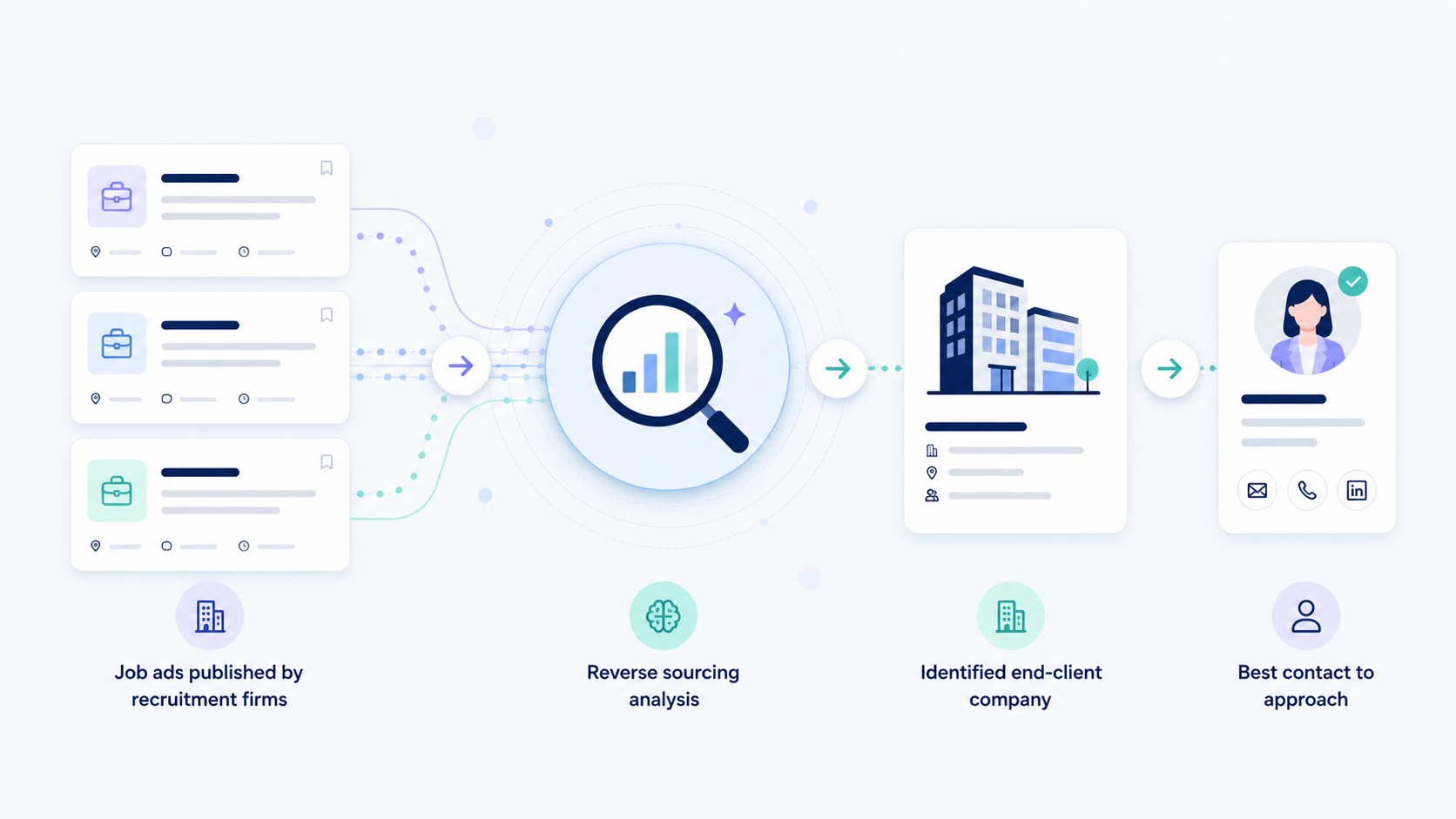
That’s exactly what reverse sourcing is designed for: starting from job ads published by recruitment agencies to uncover the end-client company behind the job posting.
In this article, we’ll look at how to spot these signals, why manual research quickly reaches its limits, and how to automate this detection with Mantiks.
Find companies outsourcing their recruitment
1. Recruitment outsourcing in a nutshell
Recruitment outsourcing means that a company delegates all or part of its hiring process to an external provider.
This can include:
- a recruitment agency;
- a staffing agency;
- an independent recruiter;
- an executive search firm;
- an RPO provider.
Recruitment outsourcing can be occasional, for example for a hard-to-fill role. It can also be recurring, when a company regularly assigns certain searches to external partners.
A company may outsource recruitment for several reasons:
- lack of internal time;
- difficulty hiring specific profiles;
- need to move fast;
- no structured HR team;
- confidential hiring;
- high volume of open roles;
- lack of expertise in a specific role or market.
In our example, a company in Lyon that assigns the hiring of a B2B Business Developer to a recruitment agency sends a very strong signal.
It is not only hiring.
It is also showing that it is willing to pay an external provider to help with recruitment.
For an agency specialized in sales profiles, this is a much more valuable prospect than a company found in a generic lead list.
2. Why these companies are priority prospects for recruitment agencies
Not every company that is hiring is a relevant prospect.
Some companies handle everything internally, never use external providers, or simply do not have a dedicated recruitment budget.
On the other hand, a company that outsources recruitment sends a much stronger commercial signal:
- real and immediate need;
- validated budget;
- openness to external partners;
- potential hiring difficulty.
In our case, the agency is not looking for “all companies hiring salespeople in Lyon”.
It is targeting:
- companies hiring sales profiles;
- through recruitment agencies;
- in a specific location;
- for roles aligned with its expertise;
- ideally with a history of recruitment outsourcing.
The real signal is not:
This company is hiring.
But rather:
This company is hiring a sales profile and has already assigned this need to an external recruitment provider.
This is the high-value signal that reverse sourcing helps uncover.
3. How to manually identify companies that outsource recruitment
3.1 Start with job ads published by recruitment agencies
The most direct method is to target job ads published by recruitment agencies, staffing firms or independent recruiters.
Certain phrases make them easier to spot:
- “on behalf of our client”;
- “our client is hiring”;
- “we are supporting a company”;
- “we are looking for our client”;
- “end client”;
- “confidential company”.
In our example, the agency specialized in sales profiles could search for queries such as:
- “on behalf of our client” + “Business Developer” + “Lyon”;
- “our client is hiring” + “B2B sales” + “Lyon”;
- “recruitment agency” + “Account Executive” + “Auvergne-Rhône-Alpes”;
- “we are supporting a company” + “Sales” + “Lyon”.
These job ads are a strong starting point, because they usually indicate that a hiring need has been assigned to an external provider.
3.2 Identify the end client, whether it is mentioned or not
Sometimes, the company name is directly mentioned in the job ad. In that case, the signal is clear: the company is outsourcing part of its recruitment, and it is easy to move from the job ad to the target account.
But this situation is relatively rare. Most recruitment agencies anonymize their job ads.
In that case, the goal is to rely on the clues contained in the ad: location, industry, company size, job title, salary, tech stack or specific wording in the job description.
For example, an ad mentioning a fast-growing SaaS company in Lyon, with a structured sales team and tools such as Salesforce, already gives strong clues about the potential end client.
By cross-checking these clues with other job ads or sources, it becomes possible to identify relevant companies to target, even when the company name is not explicitly mentioned.
3.3 Use an LLM to speed up the analysis
An LLM can help analyze anonymized job ads.
The principle is simple: copy and paste the job ad into the LLM and ask it to extract useful clues.
For example:
Analyze this job ad published by a recruitment agency and identify the clues that could help reveal the client company: industry, location, company size, context, technologies, target market, type of customers, benefits and distinctive elements. Then suggest 3 possible companies and explain your reasoning.
The LLM can help structure the analysis.
It can identify distinctive elements, reframe hypotheses and save time.
But it remains an analysis assistant, not proof.
3.4 The limits of this method
This approach has several limitations.
- An LLM does not have access to the full recruitment history of companies and may miss relevant matches.
- Job ads are often intentionally vague, which makes identifying the end client harder.
- As a result, the method is not fully reliable and is difficult to scale.
- It can be useful on a case-by-case basis, but quickly becomes too time-consuming at scale.
4. Automating the identification of companies that outsource recruitment with Mantiks
Manually identifying these companies is possible, but quickly becomes limited.
You need to identify job ads published by recruitment agencies, analyze anonymized job postings, guess the end client, cross-check clues, and then find the right contact.
For a few job ads, it can work.
But as soon as you need to monitor multiple agencies, multiple roles or multiple locations, the process becomes too time-consuming.
This is exactly where Mantiks comes in: automating the detection of recruitment outsourcing signals and turning job ads published by agencies into actionable sales opportunities.
Let’s go back to our example: a recruitment agency specialized in B2B sales profiles wants to identify companies in Lyon that have outsourced roles such as Business Developer, Account Executive or field sales representative.
4.1 Target job ads published by recruitment agencies
The first step is to start from the right job ads.
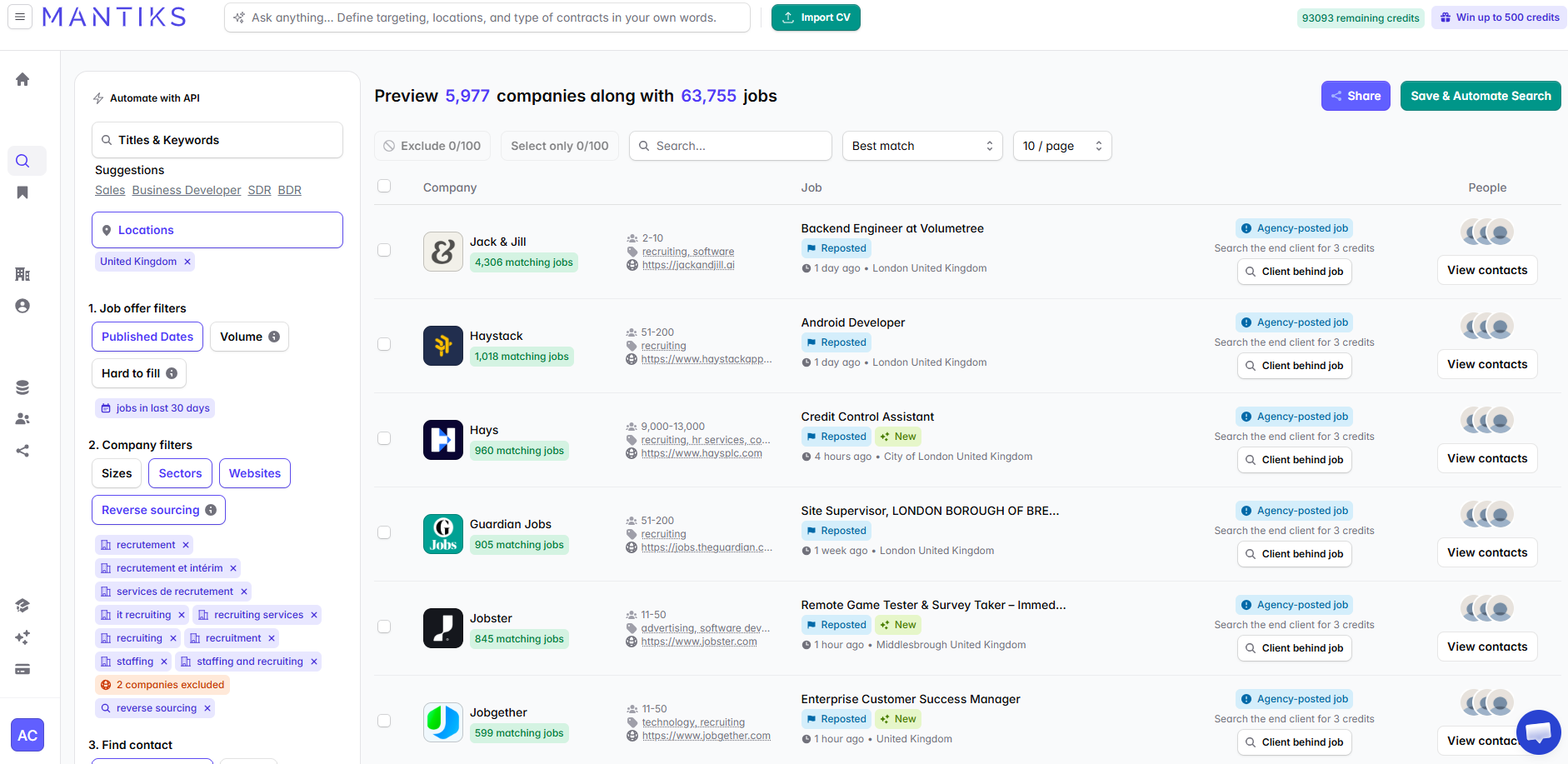
In Mantiks, the agency can filter job ads published by recruitment agencies, staffing firms or independent recruiters.
The goal is simple: avoid analyzing the entire job market and focus only on ads that already indicate a potential outsourcing signal.
4.2 Filter the roles that truly matter
The next step is to refine the search based on the agency’s specialization.
In our example, the agency could target job titles such as:
- Business Developer;
- Account Executive;
- B2B sales representative;
- Sales Engineer;
- Technical Sales Representative;
- Sales Manager;
- Sales Director.
The more precise the targeting, the more commercially relevant the identified companies will be.
A recruitment agency specialized in sales profiles does not need to analyze job ads for accountants, developers or maintenance managers. It should focus on the roles where it can genuinely create value.
4.3 Expand the job posting history to find more opportunities
The best opportunities are not always found in job ads published this week.
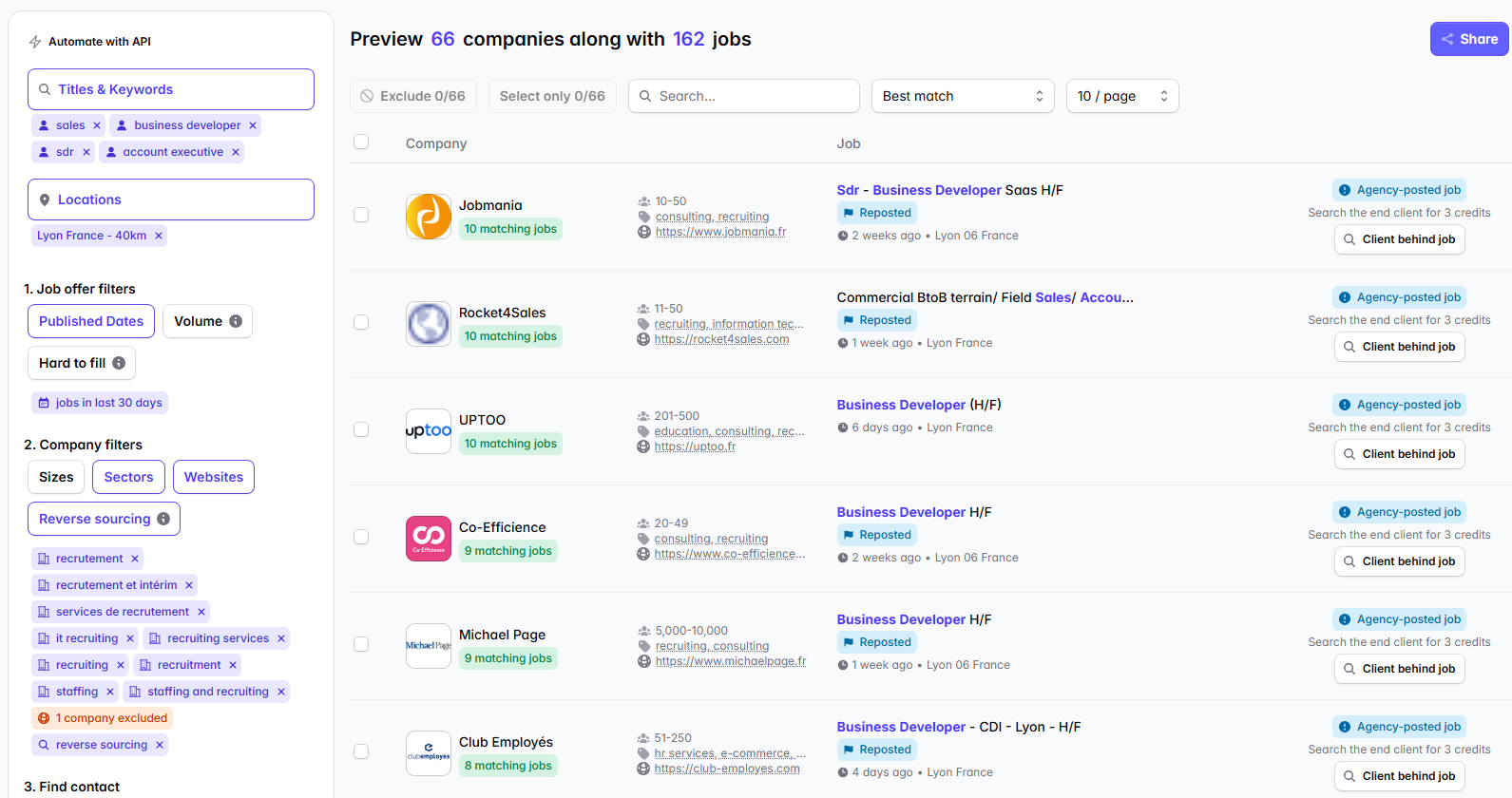
A company that outsourced a sales recruitment need 3, 6 or 12 months ago remains interesting: it has already worked with an external provider and may have new hiring needs in the future.
In Mantiks, expanding the publication period makes it possible to leverage the historical job ads published by recruitment agencies.
This increases the number of companies detected and helps build a stronger account list to prospect.
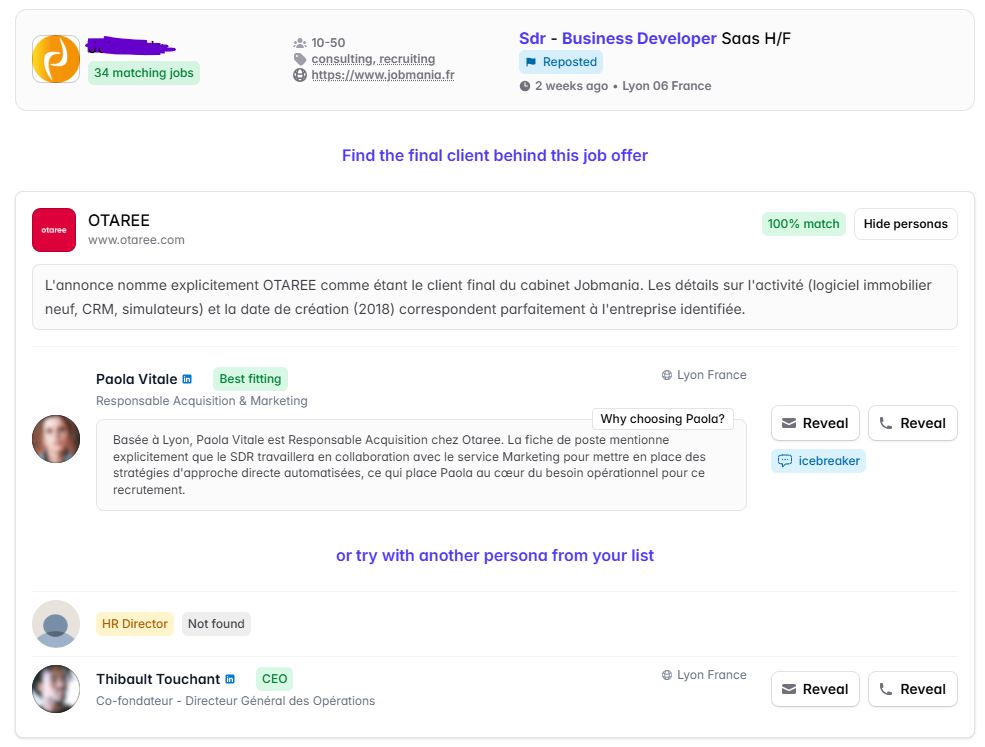
4.4 Activate reverse sourcing
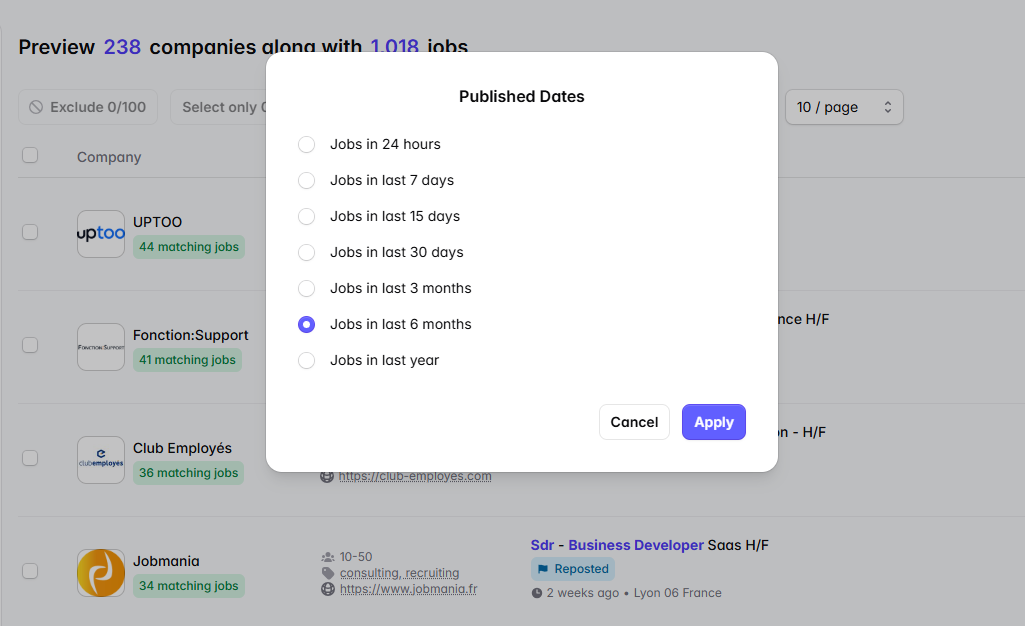
Once the right job ads have been identified, Mantiks allows the user to activate reverse sourcing.
The goal is simple: move from a job ad published by a recruitment agency to a potentially identifiable end-client company.
For example, if an agency publishes an Account Executive job in Lyon without naming the client, Mantiks can analyze the job ad and try to identify the company behind the hiring need.
This turns an anonymized job ad into an actionable sales signal.
4.5 Choose the right level of automation
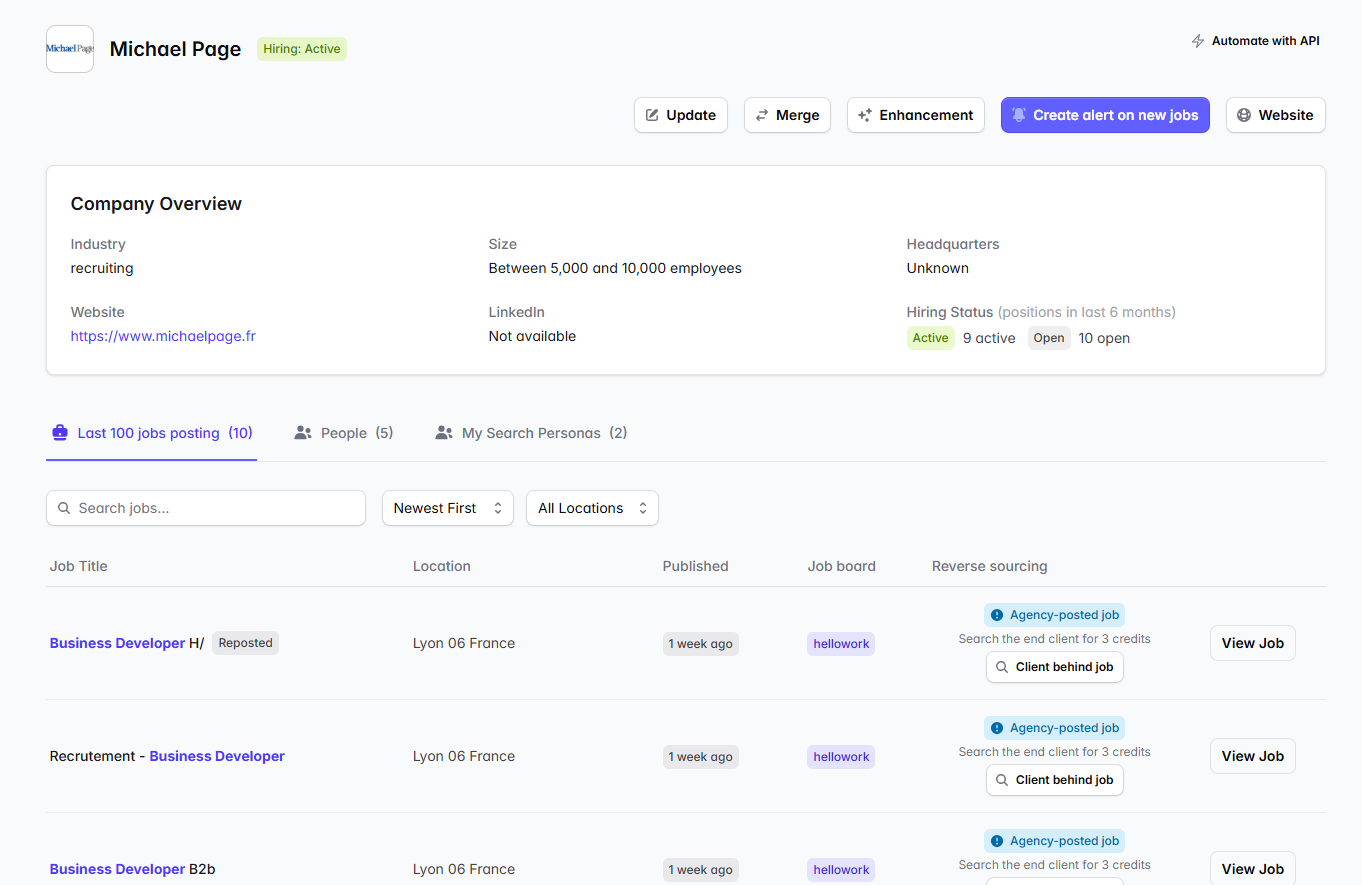
Reverse sourcing can be used in several ways depending on the need:
- on a specific job ad, using the “Find client behind the job” action;
- across multiple job ads from the same recruitment agency, directly from the agency company page;
- through an automated report on a full segment.
In our example, the agency can first test a few sales job ads in Lyon, check the quality of the results, and then launch a broader report on all sales job ads published by recruitment agencies in Auvergne-Rhône-Alpes over the past 6 months.
When a report is generated, only end clients identified with a sufficient confidence level are included, in order to keep the results commercially usable.
4.6 Identify the right contact
Identifying the company is not enough.
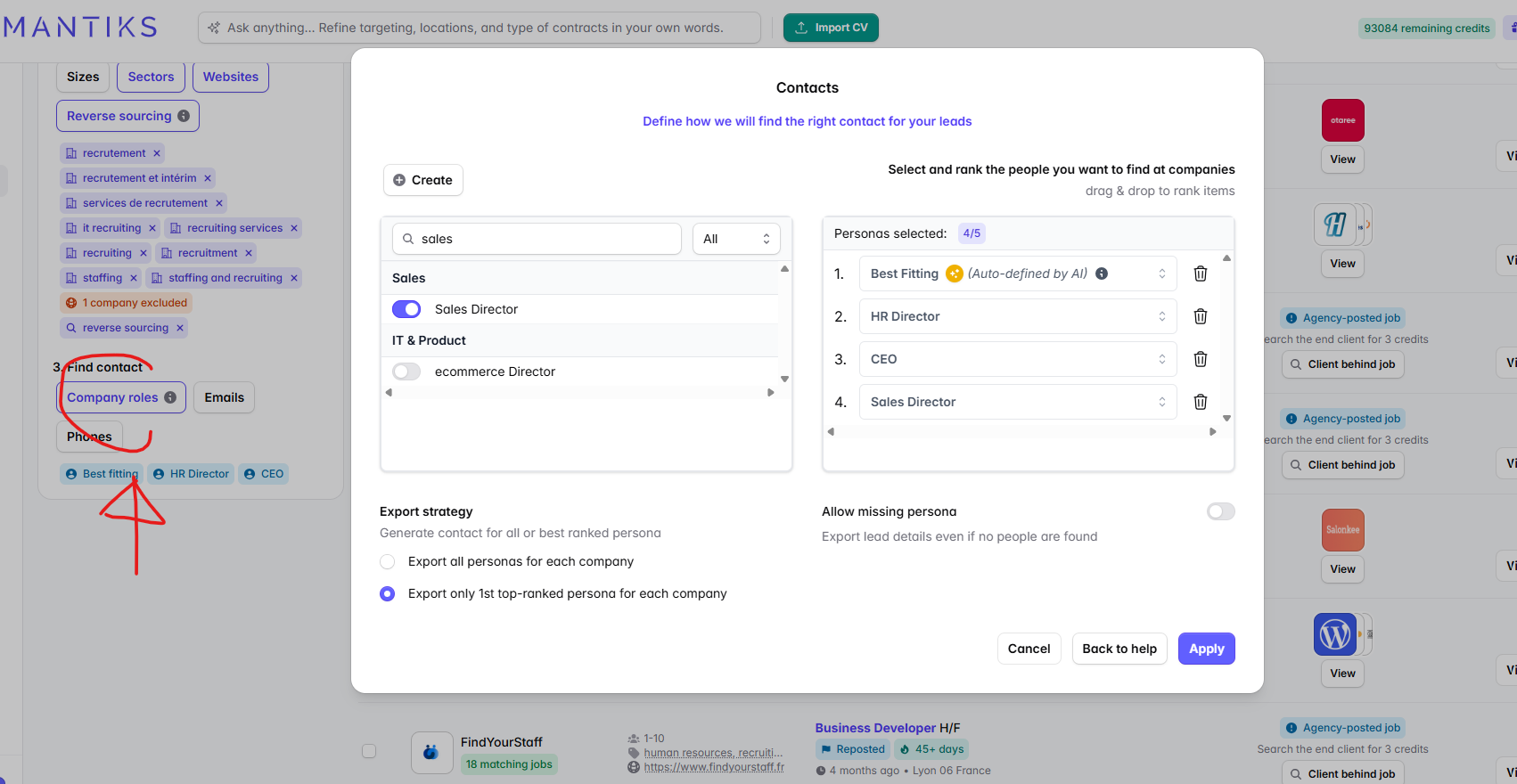
The next step is to find the right person to contact.
In Mantiks, the agency can target the most relevant decision-makers depending on the context:
- Founder or CEO;
- HR Director;
- Head of Recruitment;
- Talent Acquisition Manager;
- Sales Director;
- relevant operational manager.
Thanks to the “Best fitting persona” logic, Mantiks helps move directly from a recruitment signal to the right commercial contact.
4.7 Turn the signal into a sales approach
Once the company has been identified and the right contact has been found, the agency can build a much more contextualized outreach message.
For example:
Hi,
I noticed that you recently worked on a B2B sales recruitment need in Lyon.
We regularly support companies on similar roles, especially Business Developer and Account Executive profiles.
I’d be happy to connect and understand whether you may have similar hiring needs in the coming months.
The message is no longer generic.
It starts from a concrete signal: the company has already outsourced a recruitment need that matches the agency’s expertise.
This is what allows recruitment agencies to move from traditional cold outreach to a much more targeted, relevant and prioritized approach.
5. What this method changes in practice
5.1 Less cold prospecting
The recruitment agency no longer starts from a generic list of companies.
It starts from a concrete signal: a company has already outsourced, or appears to have outsourced, a recruitment need.
This makes prospecting more targeted, more relevant, and easier to prioritize.
5.2 More contextualized outreach messages
The sales approach can be built around a specific context:
- the role involved;
- the location;
- the likely hiring difficulty;
- a need already assigned to an external provider;
- the company’s outsourcing history;
- the type of role where the agency has expertise.
The message is no longer generic.
It can be based on a real market signal.
5.3 Better commercial prioritization
Not every company that is hiring is a good prospect.
Companies that already outsource recruitment are often more interesting to contact, because they have already accepted the idea of working with an external recruitment provider.
Reverse sourcing therefore helps recruitment agencies focus their sales efforts on the accounts most likely to be receptive.
Conclusion
Moving from recruitment data to sales prospecting is no longer about finding more companies.
It is about identifying the right moments to contact them.
Every outsourced job ad becomes an intent signal. Every role assigned to a recruitment agency reveals a commercial opening.
With Mantiks, the goal is no longer just to find leads.
It is to identify companies at the exact moment when they are most likely to buy.
This shift — from volume to timing — is what turns traditional prospecting into a real competitive advantage.
Mantiks is the best prospection platform for staffing agencies.